
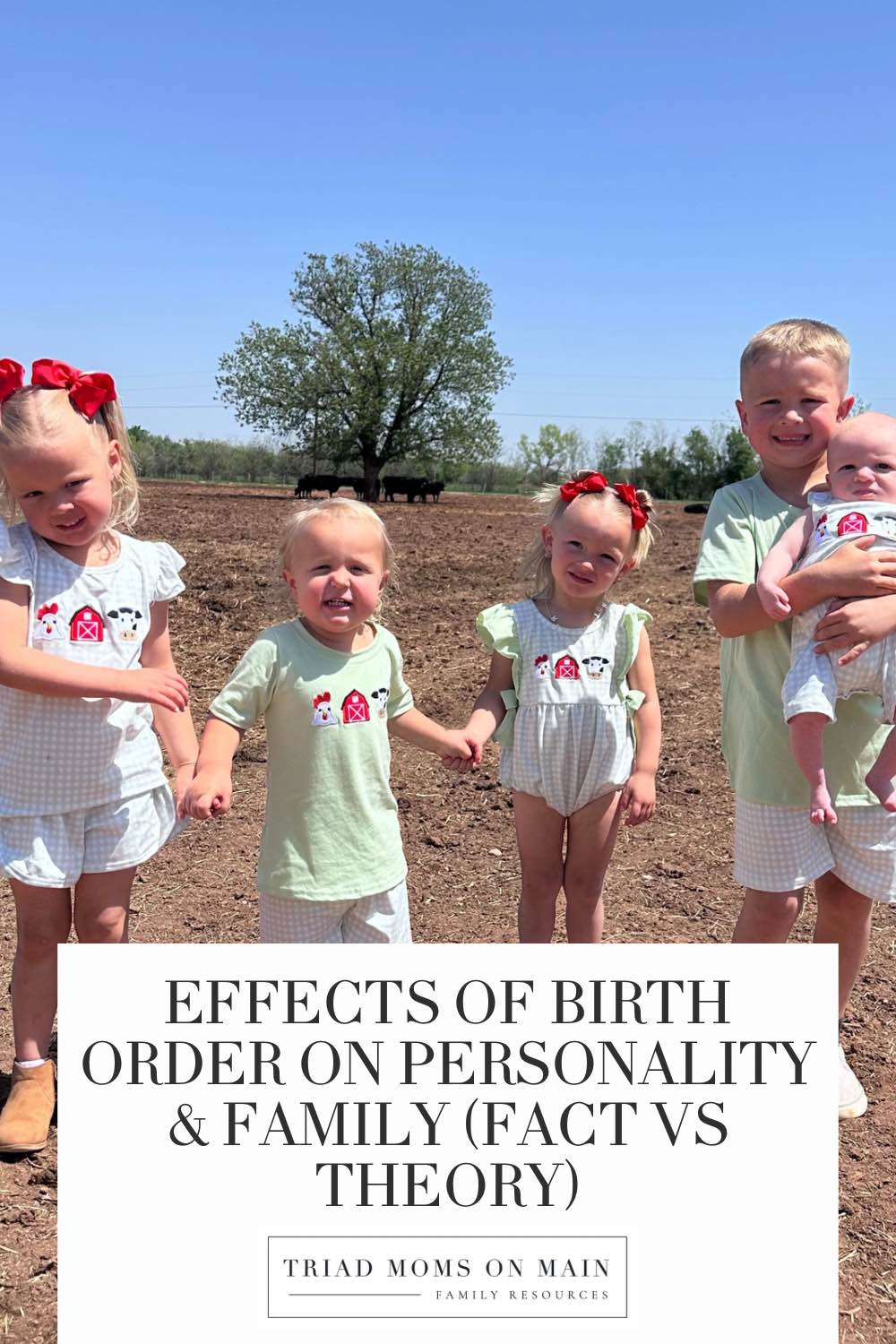
Effects of Birth Order on Personality & Family (Fact vs Theory)
If you’ve ever looked at your kids and wondered whether their personalities are shaped by birth order, you’re not alone. Birth order theory is widely discussed — but how much of it is fact, and how much is simply theory? Let’s break down what research says, what parents commonly observe, and how to think about birth order without putting kids into limiting labels.
I come from a small family – just my parents, my older brother, and me. My husband, however, is the oldest of five siblings. I used to be very intrigued by the fact that all five of them – 4 boys, 1 girl spanning fifteen years – were so incredibly different from each of the others in both personality and lifestyle.
That has changed now that I have three children of my own. My three – all girls – each have very different personalities. I find this fascinating and somewhat perplexing. After all, they have all been raised in the same environments and by the same parents; with the same rules, morals, and advantages.
What Is Birth Order Theory?
Birth order theory suggests that a child’s position in the family — oldest, middle, youngest, or only child — may influence personality traits, behavior, and roles within the family.
The idea was popularized by psychologist Alfred Adler, who believed children adapt their personalities based on family dynamics, parental expectations, and sibling competition. Over time, this theory has evolved into common stereotypes about “responsible oldest children” or “free‑spirited youngest siblings.”
But modern research paints a much more nuanced picture.
Birth Order Effects on Personality: What Research Actually Shows
Studies examining the effects of birth order on personality tend to show small and inconsistent differences when controlling for factors like family size, socioeconomic background, parenting style, and education.
First Born Children
For a time, these children are the only child in the family; they do not have to “work” to receive attention. However, they are then “de-throned” by the next child who comes along. They do what it takes to please their parents after that in an attempt to regain their prior status. Some typical characteristics of first-borns include natural leadership abilities, reliability, conscientiousness, and ambition. They are often perfectionists. They do not like surprises or changes and they have a strong need for approval. Here’s an interesting factoid: Over half of all U.S. Presidents were first-born children!
Middle Children
Middle children are not the oldest or the youngest – they are literally “caught in the middle.” Quite often, these children are directly opposite of their older siblings, but this can manifest in different ways. To gain attention, middle children learn to be very intuitive, adaptable, and creative. Because they have no “special” place in the nuclear family, their peer relationships can be very important. They can also be secretive, keeping their feelings and emotions hidden. Middle children are usually good peacemakers because they can see all sides of a situation. One researcher said, “If the First born is the CEO, the middle child is the entrepreneur.”
Youngest Children
These children are the babies! They are often doted on and even spoiled. They tend to be very social, outgoing, and entertaining. They love the limelight and, therefore, can be manipulative or risk-takers. Some examples of youngest children: Jim Carrey, Steve Martin, Drew Carey, Billy Crystal. Enough said!
Variables
There are, of course, some variables in these theories. A large age difference can throw off the usual traits and lead to more crossover of characteristics. Gender also plays a role. For example, if the first born is a girl and the second a boy, the boy is likely to show some first born characteristics since he is the first male. Children with disabilities also change the typical birth order rules because they usually require extra attention regardless of their place in the sequence. Sibling death, adoptions, and blended families can also throw a wrench into the usual regimen.
Key takeaways from research:
- Birth order effects exist, but they are much smaller than popular culture suggests
- Environment, temperament, and parenting have greater influence than birth order alone
- Personality differences within families often fade when studied across large populations
In short: birth order may influence family roles, but it does not determine who your child becomes.
Parenting tips based on the birth order information.
With first-born children¸ do not pressure them to improve; they already feel pressure to be perfect. Also, be careful about piling on too many responsibilities.
With middle children, empower them by letting them make decisions within the family sometimes; find ways to make them feel they have a special place in the family. Take time to listen to them since they tend to keep feelings concealed.
With the youngest children, be careful not to “loosen” the rules for the baby and be sure to give them some responsibility, too.
Gender & Birth Order
Check out our blog Boy First or Girl First? Which Is Better? for a blog about how gender order affect personalities.
Birth Order Effects on My Children: A Realistic View
Many parents search for answers using phrases like “birth order effects on my children” or “birth order and my daughter.” What they’re often really asking is:
“Am I parenting my kids fairly — and why are they so different?”
Here’s what matters most:
- Children experience parents at different stages of life
- Family stressors change over time
- Parental confidence and resources evolve
- Siblings influence each other as much as parents do
These factors often explain differences more clearly than birth order alone.
Common Birth Order Stereotypes vs Reality
| Birth Order Position | Common Stereotype | What Research Suggests |
|---|---|---|
| Oldest Child | Responsible leader | Often given more responsibility, but traits vary |
| Middle Child | Overlooked peacemaker | Adaptable, but outcomes depend on family dynamics |
| Youngest Child | Fun‑loving, rebellious | Often more flexible due to relaxed parenting |
| Only Child | Mature or spoiled | Often similar to firstborns in many traits |
Stereotypes may reflect family roles — not fixed personality traits.
What Shapes Personality More Than Birth Order
If birth order isn’t destiny, what actually matters?
- Temperament: Children are born with unique emotional styles
- Parenting approach: Structure, warmth, consistency
- Family environment: Stress levels, routines, communication
- Life experiences: School, friendships, challenges, milestones
These factors interact in complex ways that outweigh simple birth order explanations.
FAQs: Birth Order Questions Parents Ask
Does birth order really affect personality?
Birth order may influence family roles, but research shows personality is shaped far more by environment, parenting, and temperament.
Is the oldest child always more responsible?
Not always. While firstborns may take on leadership roles early, personality outcomes vary widely.
Are middle children overlooked?
Some feel that way, but strong sibling bonds and parental awareness often balance attention.
Should parents parent kids differently based on birth order?
Rather than focusing on order, it’s more effective to parent each child according to their individual needs.
Fact or Theory: So… Does Birth Order Matter?
Birth order can influence how children interact within the family, but it does not define intelligence, success, or personality. Understanding birth order may offer insight — but it should never be used to label or limit a child.
The most important thing parents can do is recognize each child as an individual, shaped by a combination of temperament, environment, relationships, and experience — not just where they fall in line.
By Guest Blogger Lisa Witherspoon updated by Sarah Marchwiany
Birth order theories. Have you ever thought about them? So what do you think? Do you see these character and personality traits in your children? In your spouse? In yourself?
Want to see more blogs like this and also get notifications on local events and happenings? Subscribe to our free weekly newsletters here.